Burgers on a Pellet Grill: Times, Temps, and How to Actually Get a Crust
How I cook burgers on a pellet grill: hot-and-fast vs smoke-then-sear vs full smoke, real time and temp tables, USDA doneness rules for ground beef, and the direct-flame trick that finally solves the crust problem.
 By Oleg Galeev, cooking on pellet grills since 2020, runs the OleGrill YouTube channel
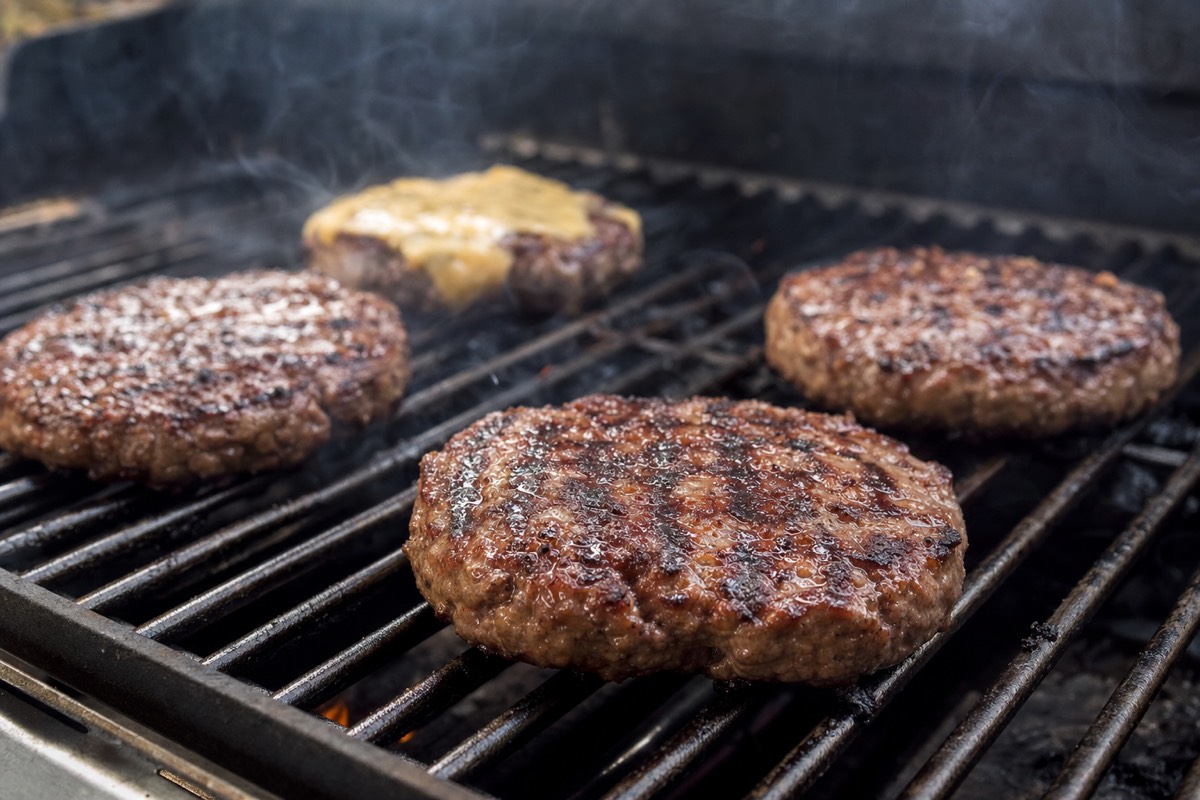
Short answer
Pellet grills cook great burgers if you pick a lane: hot-and-fast at 450°F for 8 to 10 minutes total, or smoke at 225°F to 130°F internal and then sear. Ground beef is done at 160°F, no exceptions. For real crust, use a direct-flame mode or a preheated griddle plate.
Live prices. Affiliate links: we may earn a commission at no extra cost to you. How this works.
The first burgers I cooked on a pellet grill, back in 2020, came off the grates gray. Cooked through, safe, juicy enough. And gray. No crust, no char lines worth the name, and barely a whisper of smoke even though the hopper was full of hickory. That cook taught me more about how pellet grills actually behave than any brisket since, because burgers expose the two weak spots of the platform in a single 15 minute window: short cooks absorb almost no smoke, and lid-closed convection heat browns slower than open flame. Six years and a lot of test cooks later, on every grill this site covers, I have a burger routine that beats my old gas grill. It just took admitting what a pellet grill is bad at first.
Are pellet grills good for burgers?
Yes, with two honest caveats. A pellet grill cooks burgers evenly and holds temp better than gas, but a standard 15 minute hot cook picks up almost no smoke flavor, and convection heat browns slowly. You solve both with either a low-temp smoke phase first or a hot direct-flame finish at the end.
Here is why the caveats exist. Smoke flavor comes from compounds settling on the surface of the meat over time, and burgers simply are not on the grill long enough during a hot cook. At 450°F a patty is done in 8 to 10 minutes. That is not a smoking window, it is a race. Meanwhile the fire in most pellet grills lives under a deflector plate, so your patties cook in hot moving air rather than over flame. Even heat is great for doneness and terrible for crust.
So the honest answer splits by what you want. If you want a burger that tastes noticeably of wood smoke, you have to add time at low temperature, which is the smoke-then-sear method below. If you want char and crust like a gas grill gives you, you need direct flame or cast iron, not bare grates over a deflector. Do neither and you get my 2020 burger: safe, even, gray, and a little boring.
What pellet grills get right is everything else. Set 450°F and the controller holds 450°F while you deal with buns and kids. Flare-ups mostly disappear because grease drains away from the fire. And a 20 lb hopper means nobody runs out of propane with six raw patties waiting. For weeknight volume cooking, that consistency is worth a lot.
Should you smoke burgers or grill them hot?
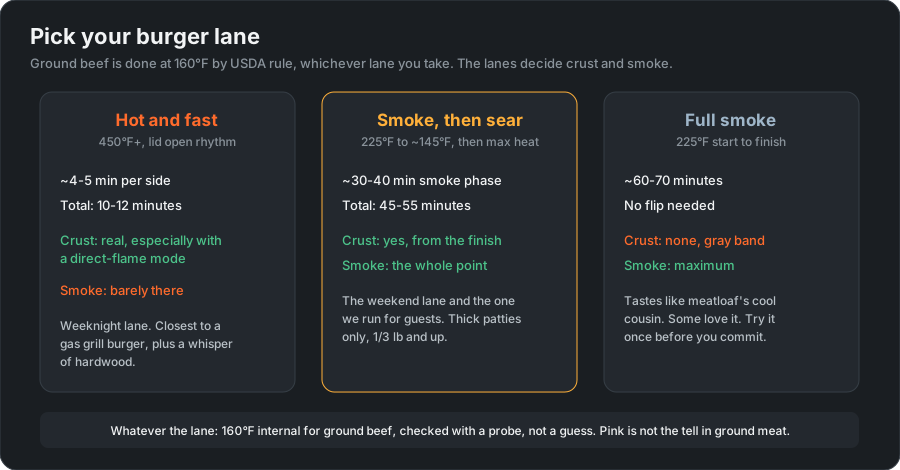
Grill them hot when you are hungry, smoke-then-sear when you want the burger to taste like it came off a smoker. Hot-and-fast takes about 10 minutes and tastes like a grilled burger. Smoke-then-sear takes about 45 minutes and layers real hickory flavor under a proper crust. Full smoke with no sear is the weakest option.
I have run all three methods back to back with the same 80/20 chuck, and the differences are not subtle. Here is how they compare:
| Method | Grill temp | Total time (3/4" patty) | Smoke flavor | Crust | Best for |
|---|---|---|---|---|---|
| Hot-and-fast | 425-450°F | 8-10 min | Faint | Moderate, better with cast iron | Weeknights, crowds |
| Smoke-then-sear | 225°F, then 450°F+ | 40-50 min | Strong | Good, from the sear phase | Weekends, thick patties |
| Full smoke, no sear | 225°F | 60-75 min | Strong | None, soft gray surface | Honestly, nothing I would repeat |
Smoke-then-sear is the pellet grill's signature burger move, the one thing a gas grill cannot copy. Run 225°F until the patties hit 130 to 135°F internal, which takes 30 to 40 minutes for a 3/4 inch patty. Then crank the grill, and sear 1 to 2 minutes per side until the internal temp reaches 160°F. The long cool phase gives smoke time to actually land on the meat, and the sear builds the crust the smoke phase cannot.
Full smoke with no sear is the version I warn people off. The flavor is there but the texture is wrong, a soft steamed-feeling exterior that no amount of toppings hides. The same logic applies to poultry, which is why my chicken on a pellet grill guide also ends every low cook with a hot finish.
Can you get a crust on a pellet grill burger?
Yes, but rarely from bare grates alone. Convection heat at 450°F browns burgers slowly and unevenly. The three fixes that work: a direct-flame mode that opens the fire pot to the grates, a cast iron griddle preheated on the grill, or smashing thin patties on that same hot iron.
Crust is a chemistry problem. Browning needs a hot dry surface in direct contact with the meat, and grates sitting over a deflector plate in moving 450°F air are neither hot enough nor dry enough to do it before the patty overcooks inside. This is the single biggest complaint I hear about pellet grill burgers, and it is legitimate.
The cleanest fix is a grill built with a direct-flame option. On the Weber Searwood 600, DirectFlame mode slides the heat diverter open so the grates sit over live fire, and the burger sear it produces is the closest thing to charcoal I have gotten from a pellet grill. Patties go from gray-prone to properly crusted in the same 4 minutes per side. Of the mid-size grills in our pellet grill rankings, it is the one I would buy specifically for burger nights, so check the current price if crust is your sticking point.
No direct-flame grill? Cast iron closes most of the gap. I preheat a griddle plate or big skillet on the grates for 15 minutes at max temp, then cook the burgers on the iron with the lid down. The metal holds the contact heat the grates cannot. It is also the only right way to do smash burgers on a pellet grill: 3 to 4 oz balls pressed hard onto the screaming iron, 2 minutes, flip, 1 minute, done. This is the same contact-heat logic behind my steak searing method, just with more surface area and less patience.
How long do burgers take on a pellet grill?
At 450°F, count on 8 to 10 minutes total for a standard 3/4 inch patty, flipping once. Thinner patties finish in 6 to 8 minutes, full 1 inch pub burgers need 10 to 13. At 225°F smoking temps, plan 30 to 40 minutes before the sear. Always confirm 160°F internal with a probe.
Time charts are guidance, the thermometer is the law, but here is what my cooks consistently show for 80/20 chuck at a true 450°F grate temp:
| Patty thickness | Weight (approx.) | Time per side at 450°F | Total to 160°F | Notes |
|---|---|---|---|---|
| 1/2 inch (smash-style base) | 3-4 oz | 2-3 min | 5-7 min | Better done on cast iron |
| 3/4 inch (standard) | 5-6 oz | 4-5 min | 8-10 min | The sweet spot for grates |
| 1 inch (pub burger) | 7-8 oz | 5-6 min | 10-13 min | Consider smoke-then-sear instead |
| 1 inch stuffed | 8+ oz | 6-7 min | 13-16 min | Probe the meat, not the filling |
Two habits change these numbers. First, preheat honestly. A pellet grill that beeps "ready" at 450°F often has grates still climbing, so I give every burger cook a 15 minute preheat past the beep. Second, dimple thick patties with a thumb press in the center. Ground beef domes as it cooks, the dimple keeps the patty flat, and a flat patty cooks in the time the table says instead of five minutes longer at the thick middle.
One flip is enough on a pellet grill. The convection environment cooks both faces at once anyway, so constant flipping just loses heat every time the lid opens. Flip at the halfway mark, probe at the low end of the window, and pull the moment the coldest patty reads 160°F.
What temp is a burger done at?
160°F internal, measured in the center with an instant-read probe. That is the USDA minimum for all ground beef, with no rest-time loophole and no medium-rare exception. Whole steaks are safe at 145°F plus a rest, but grinding changes the safety math completely.
The steak comparison trips people up, so here is the actual reason the numbers differ. On a whole cut of beef, bacteria live on the outside surface, and searing the outside kills them, which is why the USDA safe temperature chart clears whole beef cuts at 145°F with a 3 minute rest. Grinding destroys that logic. The grinder folds every surface of the meat through the interior, so whatever lived on the outside is now distributed through the middle of your patty. The center has to hit the kill temperature itself.
| Product | USDA safe minimum | Rest time | Why |
|---|---|---|---|
| Ground beef, pork, lamb (burgers, meatloaf) | 160°F | None required | Surface bacteria mixed through the interior by grinding |
| Whole beef steaks and roasts | 145°F | 3 minutes | Bacteria stay on the exterior, which the sear handles |
| Ground poultry (turkey or chicken burgers) | 165°F | None required | Poultry pathogens need the higher kill temp |
Color is not a doneness test in either direction. Ground beef can turn brown before reaching 160°F and can hold pink at temperatures past it, which the USDA covers in the same temperature guidance. A $15 instant-read probe settles it in three seconds. If 160°F sounds like a dry burger to you, the fix is fat and thickness, not a lower pull temp: 80/20 chuck at 3/4 inch, pulled at 160°F sharp rather than 170°F by accident, stays plenty juicy.
Do burgers pick up smoke flavor on a pellet grill?
Barely, during a normal hot cook. Meaningful smoke flavor needs surface time in low-temperature smoke, and a 10 minute cook at 450°F does not provide it. To taste the wood, run 30 to 40 minutes at 225°F before searing, use a stronger pellet like hickory or mesquite, and start with cold patties.
This is the question behind most pellet grill burger disappointment, and the physics are stubborn. Smoke compounds accumulate on meat gradually, they stick best to cold damp surfaces, and higher grill temperatures produce cleaner, less visible smoke in the first place. A hot-and-fast burger fails all three conditions at once. It is short, the surface dries fast, and the fire is burning too efficiently to throw much smoke.
Stack the conditions in your favor instead. Patties straight from the fridge, or even 20 minutes in the freezer, hold a cold surface longer and grab more smoke in the same window. A bold pellet matters more here than on a 12 hour brisket, so this is where I burn hickory, mesquite, or a competition blend rather than mild fruit woods. And the 225°F phase does the heavy lifting: my side-by-side cooks put almost all of the finished smoke flavor in that half hour, with the sear phase contributing crust and nearly nothing else.
If your grill has a dedicated smoke setting that hovers around 180 to 200°F, it buys even more flavor per minute, at the cost of a longer cook. I would not go below 180°F for ground beef, though. The 160°F rule does not care how the burger gets there, but I want mine moving through the low zone briskly, not camping in it all afternoon.
Can you cook frozen burgers on a pellet grill?
Yes. Run the grill at 400 to 425°F and add roughly 10 minutes to the total cook, flipping every 5 to 6 minutes so neither face overcooks while the center thaws. The doneness rule does not change: probe the center and pull at 160°F, whatever the clock says.
Should you close the lid when grilling burgers on a pellet grill?
Yes, keep it closed. A pellet grill only holds its set temperature with the lid down, since the convection system is doing the cooking. Open it to flip and probe, then shut it. Every peek costs recovery time, which is why one flip beats constant checking.
What are the best pellets for burgers?
Hickory, mesquite, or a competition blend. Burgers get so little smoke exposure that mild woods like apple or cherry barely register in the finished patty. Strong woods that can taste heavy over a 12 hour cook are exactly right for a 30 to 40 minute smoke phase.
Can you make smash burgers on a pellet grill?
Yes, but only on a griddle insert or cast iron skillet preheated at max temp for about 15 minutes. Bare grates cannot do it, since smash burgers need a flat surface for full contact. Press 3 to 4 oz balls thin, cook about 2 minutes, flip, and finish in 1 more.
Why did my pellet grill burgers come out gray?
Convection heat without direct flame browns meat slowly, so the patties finished inside before the outside crusted. Fix it with a hotter setup at the surface: a direct-flame mode, a preheated cast iron plate, or a lower smoke phase first so the final sear only has to add color, not cook the burger through.